

If you have ever walked through the “pits” at a major robotics competition—whether it is FIRST Robotics Competition (FRC), VEX Worlds, or a collegiate combat robot tournament—you instantly notice a hierarchy.
There are the teams that look like they built their robot in a junkyard five minutes before the match: scattered wires, duct tape, and bare aluminum. Then, there are the teams that look like Formula 1 crews. Their robot has a cohesive color scheme, their pit is organized, and their branding is immaculate.
In the world of competitive robotics, engineering is obviously king. But “Imagery” and branding are the queens. Winning the “Imagery Award” or securing that big corporate sponsorship often comes down to how professional your team looks.
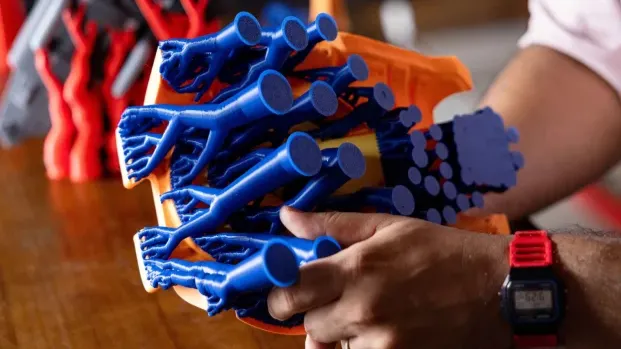
For years, achieving this “pro look” meant tedious masking, spray painting, and vinyl wrapping. But as the sport evolves, top-tier teams are ditching the paint cans. They are turning to the color 3d printer to bake their branding directly into the DNA of the machine.
The Problem with Paint in Combat
Robots live hard lives. They crash into walls, get tangled in field elements, and smash into opponents.
In this environment, paint is a liability.
- It adds weight: On a 120lb robot, every ounce counts. Three coats of spray paint plus primer adds unnecessary mass.
- It affects tolerances: If you paint a precision gear or a bearing block, you change its dimensions. A layer of paint can be 0.1mm thick—enough to make a shaft not fit or a gear bind.
- It chips: The moment your painted bumper hits a wall, the paint flakes off, revealing the ugly grey plastic or metal underneath. By the finals, your beautiful robot looks like it has a skin disease.
Multi-filament printing solves all three problems. When you print a mounting bracket in “Team Orange” filament, the color goes all the way through the part. If a defensive bot gouges your chassis, the scratch is still orange. It never looks tattered.
Structural Branding
The real power of multi-material printing is the ability to make functional parts that serve a visual purpose.
Imagine a team whose colors are Black and Neon Green. With a standard 3d printer, they might print black wheels and green hubs separately. With a multi-material system, they can print a single wheel with a black rim and a green spoke pattern fused together.
They can print gears where the teeth are distinct from the face, making it easier for the pit crew to see rotation from a distance. They can print battery holders with “Team 1234” embedded into the side in a contrasting color. This isn’t just decoration; it’s identifying information that helps judges and announcers talk about the robot during the match. “Look at the robot with the neon green intake arms!” is a much better call-out than “Look at the grey bot!”
The “Sponsor Appeal” Factor
Robotics is expensive. Teams survive on corporate sponsorships. When a representative from Boeing, Ford, or NASA walks by your pit, they are looking for professionalism.
A robot that looks like a prototype implies a team that is disorganized. A robot that looks like a finished consumer product implies a team that understands design, manufacturing, and presentation.
Using multi-color printing to create custom “swag” or functional sponsor plates is a power move. Imagine handing a potential sponsor a custom-printed keychain with their logo embedded in it, printed right there in the pit. Or pointing to the robot and showing them their logo printed into the structural chassis plate, not just stuck on with a sticker that is peeling off. It shows a mastery of modern manufacturing technology that impresses engineering mentors.
Unified Driver Stations
The branding extends beyond the robot. The “Driver Station”—the laptop and joystick console used to control the bot—is the interface between the human and the machine.
Top teams use multi-color printing to build custom ergonomic controller grips and button boxes. By color-coding the controls (e.g., “Red Button” for Shoot, “Blue Switch” for Climb), they reduce driver error under pressure. If the driver screams “Hit the Red Button!”, the operator doesn’t have to read a label; they just react to the color. This combines the “cool factor” of a custom rig with a genuine competitive advantage in reaction time.
Conclusion: Look Good, Play Good
Deion Sanders famously said, “If you look good, you feel good. If you feel good, you play good.”
This applies to engineering students just as much as athletes. When a student builds a mechanism that looks professional—crisp colors, integrated logos, clean lines—they take more pride in their work. They treat the machine with more respect.
By adopting multi-filament fabrication, robotics teams are raising the bar. They are proving that you don’t have to choose between a robot that works and a robot that looks incredible. You can—and should—have both.