

For decades, the centerpiece of the modern living room has faced an identity crisis. On one hand, homeowners crave immersion—the ability to sink into a film or a live sports event on the largest display possible. On the other hand, interior designers and style-conscious residents fight a constant battle against the “black hole” effect: the massive, lifeless black rectangle that dominates the wall when the television is turned off.
As screens have grown from 50 inches to 85 inches and beyond, this aesthetic friction has only increased. A giant TV dictates the layout of the room, often forcing furniture to point toward a dark void that disrupts the visual flow of the space.
However, a shift is occurring in luxury home design. By leveraging Ultra Short Throw (UST) technology and specialized projection surfaces, homeowners are now building “invisible theaters.” This approach delivers cinema-grade visuals when you want them and restores the peaceful aesthetic of a minimalist living room when you don’t.
The Conflict Between Tech and Tranquility
Minimalism, Japandi, and organic modern design trends all share a common goal: reducing visual clutter to create a sense of calm. These styles favor neutral tones, natural textures, and open spaces. A standard 85-inch LED panel is the antithesis of this philosophy. It is reflective, angular, and imposing. Even with “ambient modes” that display art on idle screens, the device remains a distinct electronic appliance that demands attention.
The challenge for the modern homeowner is finding a way to enjoy premium entertainment without turning their primary living space into a dedicated media room or “man cave.” The goal is a multi-purpose space—a room for reading, entertaining guests, and relaxing that can transform into a theater at the touch of a button.
The Ultra Short Throw Revolution
The solution that has gained the most traction among high-end designers is the shift from wall-mounted panels to projection. Specifically, the rise of the laser projector has bridged the gap between traditional cinema and modern convenience.
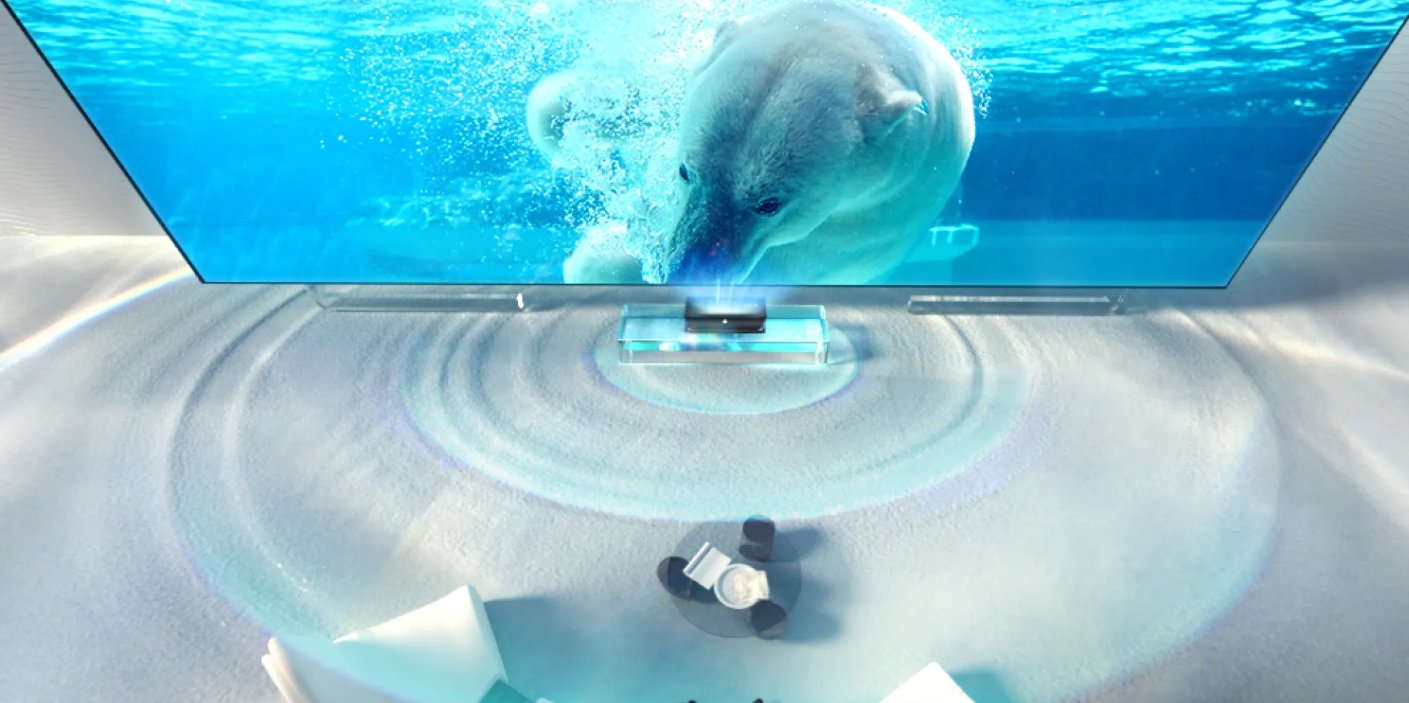
Unlike traditional projectors that require ceiling mounts, complex cabling runs, and a dark room to function, a modern 4k laser projector using Ultra Short Throw technology sits mere inches from the wall. Housed in a sleek console or media cabinet, the unit blends in with the furniture. When turned off, it is simply a piece of decor; there is no massive glass panel hanging on the wall. When turned on, it projects a massive 100-to-150-inch image directly upward onto the wall or screen.
This form factor allows for a “hidden” tech setup. The projector can be placed on a low-profile sideboard, surrounded by books or art, effectively disappearing into the room’s design. It preserves the integrity of the wall, allowing homeowners to maintain a clean, open look or even display hanging artwork that can be swapped or covered only when it’s movie time.
The Canvas: More Than Just a White Wall
To achieve a true television replacement experience—one that functions well in a bright living room during the day—the projector is only half the equation. The surface it projects onto is equally critical.
In the past, projection screens were unsightly, roll-down apparatuses that wrinkled easily and looked out of place in a finished home. Today, the technology has evolved into fixed-frame architectural elements. A high-quality projector screen designed for UST units often utilizes Ambient Light Rejecting (ALR) material. This specialized surface has a microscopic sawtooth structure that blocks light coming from ceiling fixtures or windows while reflecting the light from the projector below specifically toward the viewer.
From a design perspective, these screens look less like tech accessories and more like intentional design features. With thin bezels—or no bezels at all—they resemble a sleek, matte canvas. For the ultimate minimalist approach, some homeowners opt for motorized rising screens. These screens stay hidden inside the media cabinet alongside the projector and rise silently only when the system is powered on. This allows the wall behind the console to remain completely bare or decorated with traditional art when the theater is not in use.
Softening the Light
Beyond the physical hardware, there is a subtle lighting benefit to this setup that aligns with cozy, inviting interiors. Televisions emit direct light—they are essentially giant flashlights pointing at your eyes. This can be harsh and fatiguing, especially in the evening.
Projection relies on reflected light. The image bounces off the screen before reaching the eyes, creating a softer, more natural viewing experience that mimics how we see objects in the real world. This “softness” integrates better with the warm, diffused lighting schemes popular in modern interior design. It feels less like looking at a computer monitor and more like looking through a window.
The Verdict: Uncompromised Design
The era of choosing between a beautiful room and a big screen is ending. The “invisible theater” concept proves that technology does not have to be intrusive to be impressive.
By decoupling the display size from the physical hardware, homeowners can reclaim their walls. They can design rooms that prioritize conversation and calmness, knowing that a massive, immersive cinema experience is hidden in plain sight, ready to be unleashed the moment the lights go down. For the design-conscious cinephile, this is the ultimate best-of-both-worlds scenario.